Mostrando entradas con la etiqueta Pancho Villa. Mostrar todas las entradas

domingo, 10 de julio de 2011

The Punitive Mexican Expedition III

A brief review of a two-sided story


PART THREE

War is not merely an act of policy but a true political instrument, a continuation of political intercourse, carried on with other means
Carl Philipp Gottlieb von Clausewitz
German military theorist

De todos los Madero, fueron a elegir presidente al más tonto
Gustavo A. Madero


Once Madero was held prisoner and forced to resign presidency, Pedro Lascuráin, by the time Secretary of Exterior Relations was constitutionally elected President of the Republic as long as 45 minutes, time just to appoint Huerta in the Secretary he has just left and resign himself to presidency, automatically making Huerta the new President of Mexico.
The murder of Madero and Pino Suárez is precisely related in Taibo´s Temporada de Zopilotes.[1] Synthesizing his narration, once Blanquet held Madero, Huerta kept him in the quartermaster of Palacio Nacional aside the Vice-President and General Felipe Ángeles. But there were no a visible head of the coup d´etat, and Huerta took advantage of this situation shaping up as the leader once the very promoters of the revolt had been killed one and subordinated the other to Huerta´s orders. He sent a hitman, Major Francisco Cárdenas, to kill Madero in these terms:

– We know, Cárdenas, that you´re a man who knows how to do what is ordered. The one that killed a Santana[2] can easily kill a Madero. Don´t be shy. It´s not the first time you kill a man.
– Yes, my General, but no one this size.
– Very shortie, he is.[3]
– And must die all three?
– Well, Ángeles may stay, but the other two must die today without dilation.

So Madero was taken from his prison and introduced in a rented Protos and Pino Suárez in a so rented Peerless, the first escorted by Major Cárdenas and Corporal Francisco Ugalde and the second escorted by Corporal Rafael Pimienta and Officer Agustín Figueres. It was 2220 hours on February 22nd 1913,[4] and the two cars left Palacio Nacional heading to Lecumberri Penitentiary, less than a mile away. Parking behind the prison, Cárdenas shouted, pushing Madero: “Off you go, damn it!” and shoot him twice in the head, from behind. Pino Suárez tried to run but he was reached by the bullets of Pimienta; wounded and with a broken leg, Vice-President was killed by Cárdenas and Pimienta. The autopsy showed thirteen wounds in his body. The corpses were buried in a ditch and covered with rocks.

Palacio Nacional after apprehension of Madero and Pino Suárez
 
With the end of maderist presidency, Huerta decided to dissolve Congress and begins trades with the American Embassy commanded by Henry Lane Wilson who, in fact, actively participated in the coup d´etat generating a political agitation in the days between the Bernardo Reyes and Félix Díaz rising and the killing of Madero.

 Mexico, history of: Huerta mocked in political cartoon. Photograph. Enciclopaedia Britannica Online. Web. 10 Jul 2011. Swann Collection of caricatures & cartoon/Library of Congress, Washington D. C. (LC-USZ62-85449), by Thomas E. Powers, 1913

All these illegal acts unchained the rage of the army Generals (very late, I should say) and provoked the signing of the Plan de Guadalupe by General Venustiano Carranza Garza. One should give a glimpse on this man: born in Cuatro Ciénegas, Coahuila, he was son of a prominent farmer and elected Mayor of his town. He held a political struggle against Governor Garza Galán supported by Bernardo Reyes, Commissioner of Porfirio Díaz, in 1894. After that he supported the campaign of Reyes against Porfirio Díaz and added to Madero´s campaign from exile in San Antonio, Texas.
Once Revolutionary Army conquered Ciudad Juárez, Madero elected him to be Governor of Coahuila, a political place he had desired since he was Mayor. After that and when Madero was elected President, Carranza Garza occupied the Secretary of War and Navy. He seemed not to like Villa´s natural scent.

From the left: Emilio Madero (?), Pancho Villa, Venustiano Carranza, José María Pino Suárez y José Medinabeytia, in Chihauhua, 1914. Villa and Carranza viewing opposite sides. They did not like each other.

Aware of Huerta´s coup, Carranza declared himself in default and refused to recognize the Huerta´s government, holding the rank of First Chief of the Revolution (a rank he desired since the days of first Mexican Revolution), as said in the Plan de Guadalupe, proclaimed in March 26th 1913.[5] In southern México, on the other hand, Emiliano Zapata, leader of Liberating Army of South, modified the Plan de Ayala, document in which people of Morelos state deplores Porfirio Díaz regime to deplore Huerta´s coup, without subordinating to Carranza´s orders and begins a parallel war against Huerta.[6]

 Palacio Nacional. In the middle, Villa sited in Presidential Chair. To his left, Zapata, holding a huge hat.

Carranza rise the army from northern México in three big corps: Northwest Army under command of General Álvaro Obregón in Sonora where José María Maytorena was Governor, Northeast Army under command of Pablo González Garza in Coahuila, state governed by Carranza himself and, lately, the Northern Division commanded by Francisco Villa in Chihuahua, where the Governor was Abraham González.[7]
Once up in arms, Carranza´s army was easily defeated and The First Chief crossed all the biggest states of northern México from Coahuila to Sonora to join Obregón´s army. In Chihuahua, on the other hand, the revolt wasn´t unified and there were many guerrillas fighting against federal troops, one of these commanded by Villa who, lately, will be elected commander in chief of Northern division. In this political convulsed river, the fisherman made them profit and Pascual Orozco negotiated with Huerta´s government, legalizing it. So he was pursuit and defeated by Villa lately.
Carranza sent to Chihuahua to Juan Sánchez Azcona and Alfredo Breceda trying to get Villa´s submission to his very power. Villa decided to join the Constitucionalista army (so named by Carranza) only if Chihuahua territory was not to be under the command of Sonora´s military and himself was not to be under any command. By the time, Chihuahua was torn by bandits and “gavillas” of thieves so, Villa, far from face the government troops dedicated his forces to pursuit and eliminate these gavillas, bringing back to the state the tranquility it has lost, wining, by the way, the respect of people cause his army was severely punished if there was any act of vandalism after their entrance to any town.[8]
Villa was never subordinated to Carranza´s power and operated always in his own terms of internal government and chains of command keeping in mind his primary objective: the defeat of Huerta. But Carranza was looking forward, watching himself in the Presidency. And Villa and his power in the biggest state of the Republic was an obstacle to him. When the fight moved southbound and won territories and cities, one of those being Torreón, Coahuila, Carranza begun to show an authoritarianism that divided the army. 

Maybe the most popular photograph of Pancho Villa, misknown as The Fall of Torreón, it was taken in Zacatecas.
Once Torreón was in hands of the revolutionaries, Carranza tried to separate the División del Norte sending Villa and a little column of this corps to support Pánfilo Natera´s army in the assault to Zacatecas city. Villa refused, in polite terms to do so and Carranza insisted. It was June 11th 1914. Carranza received a telegram from Villa proposing to move not only a column of his forces, but the entire Division, but Carranza insisted in sending not only three thousand, but five thousand men to support Natera. The next day, Villa sand a new telegram to Carranza saluting him and apologizing to be unable to help Natera questioning him for his decision to attack Zacatecas by himself instead of waiting for Northern Division. By the way (maybe as a probe to Carranza), Villa asks the First Chief to name a new commander of the Division. Natera failed in taken Zacatecas; even more, his army was almost annihilated. Carranza answered Villa that, if he had accomplished the orders himself had send Villa, Zacatecas would be under their rules. Taibo says:

In the conference, Carranza argued that if Villa had not received the supports that Carranza send him in Torreón with Durango corps, (Villa) he would not been able to take it. He is not proposing Villa to subordinates to General Natera; it´s all about that “he takes the city and expedites the way for himself southbound”. And, insists, victim of the authoritarianism that obsessed him: “Natera will stand for two days. Send (Eugenio Aguirre) Benavides, (Jesús) Ortega, (Calixto) Contreras or whomever you want”.
It has become an authority duel begun as a political maneuver (…). “The reason that was heavier in the spirit of Mr. Carranza to avoid Villa to take Zacatecas was that, once it has fall, he could be able to continue his march to México City”. [9]

Villa resigned to the command of the Northern Division and called Felipe Ángeles (that one that was held prisoner aside Madero) to give him the command of the forces. Ángeles fears the cracking of the Division which, in fact, it´s about to happen. Some of the military menace to go to the sierras and begin a guerrilla against Carranza. Villa sent a telegram to General Álvaro Obregón in Sonora, informing him about his resignation. Obregón and Villa had met in Ciudad Juárez, Chihuahua. The meeting was, surprisingly, witnessed by General Pershing; there is a photo in which a young Lieutenant George Patton shows a naive smile. Carranza asked the generals supposedly gathered in the telegraph office in Torreón to designate the chief that would replace Villa. The generals answered asking Carranza to reconsider Villa´s resignation in view of his services to revolution. Carranza asked to designate another chief. The generals stand clearly that Carranza would not be able to go over the División del Norte and its chains of command based in the popular election of its chiefs:

We could, following the example of sir General Villa, let the command of our troops dissolving so the División del Norte, but we cannot deprive our cause of a so valuable element of war. So, we are about to convince the chief of this División to continue the fight against Huerta´s government as if no unpleasant event had happen today and we admonish you to do same, to defeat our common enemy.[10]

Carranza, deaf to reason, asked them to designate a new chief. General Maclovio Herrera, partner of Villa since the beginnings of Madero´s revolution, and infinitely more prosaic, telegraphed to Carranza:

Mr. Carranza: I´m aware of your behavior toward my General Francisco Villa. You are a son of a bad woman.[11]

But the other generals, modestly more moderated, answered:

Torreón, June 14th, 1914. Mr. V. Carranza. First Chief of the Constitucionalista Army, Saltillo, Coahuila. Your last telegram made us to suppose you had not or wanted not to understand our two last telegrams. They says in its medullar part that we do not take in account your order to General Villa resign the command of the División del Norte, and we could not assume another position against this apolitical, anti-constitutional and anti-patriotic action. We have convinced General Villa to understand that his compromise to the Homeland obligates him to continue in command of this corps (…)[12]

Carranza would be, in a near future, pursuit by Villa in his runaway from Mexico City to Veracruz and Coahuila. When Carranza (enthroned as the Máximo Mexicano) knew of the approach of Villa´s army by the north and Zapata´s army by south, charged a train with all his stuff, the Presidential Chair included, and begun a itinerant government trying to emulate President Juárez. When the villistas finally reached Mexico City, says the legend, one of the troopers saw the chair in which Villa and Zapata was photographed and asked:

And we are killing each other ´cause of this thing?[13]

Villa and Zapata entering México City. Villa surprisingly in uniform and Zapata with his charro usual clothes.

[1] Taibo II, PI, Temporada de Zopilotes, una historia narrativa de la Decena Trágica, editorial Planeta Mexicana, México, 2009, 155 pp.
[2] Refering to the killing of Santana Rodríguez, a magonist guerrilla from Veracruz.
[3] Sarcasm related to Madero´s size: he was 4´ 8” tall.
[4] Coincidently, this day was celebrated the birthday of George Washington with a reception in the American Embassy. After ordering the murder of Madero, Huerta went to the Embassy to celebrate with Ambassador Wilson.
[5] Instituto Nacional de Estudios Históricos de las Revoluciones Mexicanas, INEHRM, Página del Bicentenario, consulted on http://www.bicentenario.gob.mx, on July 10-07-2011.
[6] Instituto Nacional de Estudios Históricos de las Revoluciones Mexicanas, INHERM, Op. cit.
[7] Salmerón P, La Divisón del Norte, the land, the men and the history of a people´s army, Booklet, Planeta Mexicana editorial, México, 2006, page 299
[8] Salmerón P, Op. cit.
[9] Taibo II, PI, Pancho Villa, Una biografía narrativa, Editorial Planeta Mexicana, 2006, México, pp. 372
[10] Salmerón P, Op. cit. page 454
[11] Taibo II PI, Op. cit. Page 373
[12] Salmerón P, Op. cit. page 456
[13] For most fighters, “the chair” was the coloquial way to refer to the Presidency, to the Power of the Nation. Even today, political struggle is called the Fight by the Chair.

martes, 24 de mayo de 2011

The Punitive Mexican Expedition II

A brief review of a two-sided story

Expeditionary troops south the border


PART TWO

México es kafkiano,
no tenemos pa´ elegir.
Como Cristina Pacheco dijo:
aquí nos tocó vivir.
Salvador Vélez Rodríguez / Ricardo Marcos-Serna
(J)oda a la Revolución, fragment


(…) desde el momento en que un gobernante no respeta la ley, no tiene otra regla a qué sujetar sus actos sino a sus propias pasiones (…)
Francisco I. Madero


One can´t tell the story of these Revolutions without making time gaps between its chapters. A Revolution is not merely a social movement but a living being, an animal that feeds in haunted places, that drinks blood of the men dying in battles, that dreams of strategy, betrayal, loyalty, braveness and fear. Who said “War is politics continued by other means”?
The first ten years of 20th Century were harmful for Mexico. It´s Government ruled out by a tyrant during thirty years, society as fragmented as Congress, earthquakes both political and geological, drought, corn and bean production reduced, forced armed recruitment, famine, all of these things contributing to a rise of political opposition.[1] 
Madero crossed the American-Mexican border, briefly, on November 20th 1910. Hopping, perhaps, to see the country set in flames, he did found no more than a reduced group of men in the so called Ciudad Porfirio Díaz (today named Piedras Negras, Coahuila) and shortly after that returned to the USA and waited until February 14th 1911 when he crossed again southbound at Zaragoza Distrito Bravos, Chihuahua, and lead definitely the revolt until General Díaz resigned Presidency on May 25th 1911. 
Trough those 186 days, Mexico lived and starred the first Revolution of the century in the wide world. And was in this period of 186 days when Francisco Villa begun to gain a place in History. Graded as Captain on Revolutionary Army, Villa was subordinated to a chief (Máximo Castillo) that he did not consider other thing that inept and dumb. 
The Revolutionary Army faced a Federal Army in deplorable conditions: payless, hungry, barefoot in some cases, most of its troopers forced to be there and facing an irregular corps of well motivated men that gained confidence as they gained terrain, as they took towns and cities, sometimes in a bloody way, sometimes –as in the case of Colima and Michoacán, without shooting a single bullet.

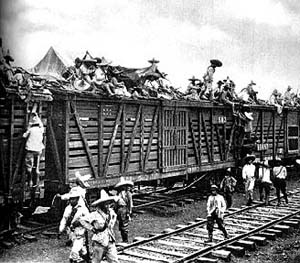
Young Federal soldier in a train station in México


But in towns they won by means of force some men did outstand as brave warriors, some as unsubordinated and some as proactive fighters. One of these battles was to become a milestone for the triumph of Revolution: the battle of Ciudad Juárez.
Madero and his Generals after the fall of Ciudad Juárez in the front of La Casa de Adobe.
Sit from left to right, Caranza; behind him, Villa. Left to Villa, Gustavo Madero. 

 Obviously important to survival of the near to end Revolution and essential for supplying and feeding the villista army in the next to come Revolution, Ciudad Juárez became a centerpiece in the revolutionary map.
In this absurd fight a touch of color: Máximo Castillo, one of maderista chiefs was stand aside Francisco I. Madero in the battle of Casas Grandes, prior to battle of Ciudad Juárez. They were losing the skirmish and bullet flied near to them. “Let´s lay down!” they say Castillo shouted. “No” Madero answered. “We´ll got dusty”.
On may 10th 1911 begun the siege of Ciudad Juárez under the menace of an American intervention if one single bullet cross into American territory (this absurd pretentious way of American Government), supported by the displacement of 20 thousand soldiers to the border region ordered by President Taft.
South of Ciudad Juárez at la Casa de Adobe, a rudimentary house turned into a Op-Center Command of revolutionary forces, Madero asked politely the surrender of the city.

In Federal Army camp, commanded by old General Juan N. Navarro, they received the request as a joke:


(…) ya sabemos que la gente de El Paso les está llevando uniformes, armas y lonches (…) Lo que deberían traerles son huevos que buena falta les hacen (…)


“I could not tolerate this” Villa said. But Madero prohibited any military action without his consent, partly because of stating his command before his troops and mostly because the American threat. Villa and Orozco decided to order their men incite a battle with federal soldiers (while both of them were at El Paso slurping ice cream). The men accomplished their mission involving federal troops in a firefight. When Madero was aware and asked Villa and Orozco for responsibilities, it was too late. Orozco and Villa, maybe smiling, shrugged and said: “Pos…”. “What are you going to do?” said Madero and ordered a full attack on Ciudad Juárez that finally fall down a day like this, May 21st, one hundred years ago just 9 miles from where I´m sitting now, writing these words. Four days after that General Díaz left Mexico in the boat Ypiranga, six months after that Madero swore as President of the Republic and three months after that he was killed in Mexico City.
Once Madero got to Mexico City on June 7th 1911 (that very morning an earthquake hit the Nation´s Capital), he summoned to general voting and won the Presidency against “official” candidate Francisco León de la Barra. On November 6th 1911, Madero protested as President and José María Pino Suárez as Vice-President.
President Madero and Vice-President Pino Suárez


Many of the veterans of maderista fights felt that Madero betrayed them ´cause they´re situation in the country was the same than before the Revolution and the so promised lands to come haven´t came yet. So, many of them rise in arms again, this time against the regime they helped to install. One of the leaders of that new Revolution was named Pascual Orozco, the man that incited the Ciudad Juárez combat aside Francisco Villa, the latest still loyal to Madero, fight against Orozco and his colorados. While this was happening along all the nation, Madero received the morning of February 9th 1913 with the notice of Generals Bernardo Reyes and Félix Díaz had been released from jail by General Manuel Mondragón and that they was leading a military coup d´etat against him. The Mexico City chief of gendarmerie, General Federico González Garza gathered in Presidency Residence, the Chapultepec castle, his forces and many cadets of the Military College to escort Madero all the way to Palacio Nacional where Bernardo Reyes, seditious General of the revolt, had just been killed by Government forces.
González Garza was injured and Madero had to replace him with General Victoriano Huerta.


 General Victoriano Huerta

From this moment and so on until Madero´s capture and dead, I can see a shocking parallelism between Francisco I. Madero and Salvador Allende fall in Chile´s military coup.
Madero needed a gendarmerie commander able to guide the defense of the City so, a military man was the better option and Madero chose Huerta ´cause of his military expertise. Allende in Chile did so with Augusto Pinochet even when Orlando Letelier (by the momento of the coup d´etat on September 11th 1973 he was the Defense Minister) tried to aware Allende about the imminent betray of Pinochet, asking Allende to kill him. In Mexico, sixty years before, Gustavo Madero tried to beware his brother Francisco about the imminent betray of Huerta, asking Madero to kill him.
None of both presidents listened to their advisors and both of them were betrayed by those whom cried before them on a pledge allegiance. Madero faced Huerta in Palacio Nacional and Huerta cried out he was loyal. Allende faced Pinochet in Palacio de la Moneda and Pinochet cried out he was loyal.
Up: Francisco and Gustavo Madero.
Down: Orlando Letelier and Salvador Allende


So, Madero was held prisoner in Palacio Nacional by General Aureliano Blanquet, an old military who commanded the firing squad that killed Maximiliano I de Habsburgo in the end of the Second French Intervention in Mexico. Madero was held prisoner with Vice-President Pino Suárez and General Felipe Ángeles, former chief of the Brigada de Artillería commanded by Pancho Villa. Madero and Pino Suárez were murdered in a dirty and dark street aside to Lecumberry jail. Ángeles was set free as a consideration to his military rank. Big mistake, indeed.

 In coat, Huerta. Two sides to his left is General Aureliano Blanquet


Retired to civil life in Chihuahua, General Francisco Villa went to México for Madero´s burial and cried on the coffin, possibly swearing for revenge. Back in northern Mexico, Villa rise the men who fought aside him against General Díaz and General Orozco and begun the campaign that will end with the constitution of the División del Norte. A regular, well organized and perfectly girt and incredibly mobile army of more than thirty thousand men and a similar number of horses, formed by near of fifty brigades in which, even in the smallest, the head was custodian of the power if his men.
So the División del Norte faced Huerta´s army aside the other Divisiones: that from Sonora under command of Álvaro Obregón and that of Coahuila under command of Venustiano Carranza. This man, the long white beard, the spectacles, the high boots, will become a center character in the future of Villa and the American invasion leaded by Pershing in 1916.


Venustiano Carranza, self-proclaimed "El primer Jefe", The First Chief


[1] Aguilar-Camín H, Meyer L, A la sombra de la Revolución Mexicana, Cal y Arena edit., México 1989

sábado, 29 de enero de 2011

The Punitive Mexican Expedition

Brief review of a two-sided story


Patria, México, febrero veintitrés,
dejó Carranza pasar americanos;
dos mil soldados, doscientos aeroplanos,
buscando a Pancho Villa, queriéndolo matar.
Corrido Popular Mexicano

On we sweep with threshing oar,
our only goal will be the western shore.
Led Zeppelin
 Part One

          Mexican Revolution begun, officially, on November 20th 1910, at 1800 hours. A strange case of a Revolution with an exact date to begin,[1] cited by its promoter, Francisco Ygnacio Madero[2] in San Antonio, TX:
           
7th: the 20th day of November, from 6 P.M. hereinafter, all the Citizens of the Republic take up arms to throw from Power the authorities that actually govern it (Towns separated from communication routes should do it the Eve)[3]
  
          Madero, born in Coahuila, had powerful democratic convictions and wrote a book named The Presidential Succession in 1910, The National Democratic Party in which he did not only criticized General Porfirio Díaz´s regime, but promoted democracy as the only way to improve life conditions for the Mexican countrymen, for the moment, the gross of Mexican population. At January 1910, Madero arrived to Chihuahua making electoral campaign and meeting Abraham Pablo Ladislao González Casavantes, lead of Chihuahua´s anti-reelection movement. El Imparcial, Government official newspaper, published the next article in January 29th 1910:

THE FAMOUS MADERO´S TOUR. Chihauhua, January the 17th.- Completely unnoticed passed the presence of the so called “lead” of Anti-Reelection Party, Francisco I. Madero, who arrived this City yesterday morning from El Paso, TX. Here, as in Sonora and Sinaloa, Madero got a rounded failure in his political propaganda, such expected thing ´cause he lacks the capabilities necessary to carry on the task he has taken in his hands as if it was a sport;[4] as an orator, politician and writer, he´s a nullity. His famous book The Presidential Succession, filled with mistakes and contradictions, has been knackered in all its arguments by people capable that have analyzed it. The new “Messiah”, deeply disappointed for he´s lack of success, left today heading to his wine lands, where he probably stay in retirement, convinced he´s going nowhere.[5]

Francisco I. Madero,
Leader of Anti-Reelection Party
          It’s said that Madero and Villa meet for the first time there, but it might be a mistruth ‘cause Madero would damage his image meeting a notorious bandit in from northern México. 
          Madero had been part of Liberal Mexican Party of Flores Magón brothers since 1903, but separated from it founded the Mexican Anti-Reelection Centre, recruiting independent power people from almost all the states of the Republic facing the reyistas, supporters of General Bernardo Reyes, military man possibly the successor of Díaz in presidency. But Díaz, about to celebrate his 80th birthday on September 15th 1910, coincidently with National Independence anniversary, sent Bernardo Reyes in a negligible commission to Europe clearing his way to reelection. Reyistas, disappointed and headless, found in Madero´s movement their claim and added to his cause. This is probably the moment in that a political movement turned on an armed revolution: Madero´s party and the reyistas celebrated a national convention in México City, 1910, in which Francisco Madero and Francisco Vázquez Gómez formed the duo trying to get the Presidency. Díaz could not allow this people get the power and instrumented an insidious harassment campaign on them, leading to Madero being arrested aside to Roque Estrada, his speaker colleague at Monterrey, Nuevo León:

DON FRANCISCO I. MADERO WAS ARRESTED IN MONTERREY. Monterrey, June the 7th.- Last night at 11:30, moments in that Madero and other people were at train station ready to aboard and head North, he was arrested by Lieutenant Colonel Morelos Zaragoza, police general inspector, who made of Madero´s knowledge that he was being arrested ´cause of the responsibility derived of constant calls he had made to people to rebellion and following a Federal Judge order. Mister Madero was immediately taken to police station where he was briefly held prisoner while he was sent to County Jail, where he´s since.[6]

General Porfirio Díaz Mori, Mexican President from
November-December 1876, February 1877-November 1880 and
December 1884-May 1911
          
         After that, Madero was sent to San Luis Potosí and held prisoner restricted to City limits. Díaz instrumented in October a pantomime to send Madero to Jail and instructed Colonel Samuel García Cuéllar, in México City, to telegraph San Luis Military garrison orders to re-arrest Madero. The telegrapher, José H. Portillo, maderista at the time, sent the message to San Luis where the receiver telegrapher, Rubén Durán, another maderista, warned Madero. He sneaked from the city on October 5th, heading the border and reaching San Antonio, TX, where he was received by the anti-reelection party adepts and promulgated, the so called Plan de San Luis Potosí. In the northern side of the Border, Madero´s people moved frenetically to get weapons and money to support the fight they were about to begin. 
          Here is a glimpse of the emerging involvement of some Americans in the saga of the revolution.
          As I said in the beginning, Mexican revolution was dated to begin at November the 20th but, as a matter of fact, it began seven days before, when Toribio Ortega Ramírez, Cuchillo Parado, Chihuahua´s anti-reelection leader knew of the movement of Federal Army troops moving to his hometown and made a revolt in this little sierra city and head the mountains immediately.[7]

General Toribio Ortega Ramírez
The first skirmish of the Mexican Revolution 
was led by this man in Cuchillo Parado, Chihuahua

          It was in Chihuahua Sate, cradle of Revolution, where Villa had his putative hometown. Would it be pretentious to ask –retoricaly, who was Pancho Villa and after made a circumspect apology of the motifs pushed him to do what he did? Sure it would. It will be as pretentious as calling an expedition “punitive”, the castigadora. It would be as pretentious to do that as it would be to pigeonhole Villa´s role in the Mexican Robin Hood paper that most of people know, stereotyped by movies and official history in both sides of the Mexican-American border. Villa was not a social bandit, nor an avenger. He was a man that read between the lines of that war the chance of benefiting all people of his land, a territory that for Villa was everything: a little strip of the planet extending from Texan border cities to Mexico City, a place that, by the way, he didn´t like.[8]
          So, who was this Pancho Villa?

In San Juan del Río, at July 7th, 1878, before me, Jesús García Quiñones, Civil Judge, came Agustín Arango aside witnesses Gregorio Acevo and Ignacio Alvarado and stated that: June 5th by the afternoon was born in Río Grande a child to be named Doroteo, legitimate son of Agustín Arango and Micaela Arámbula and that his paternal grandparents are Antonio Arango and Faustina Vela and his maternal grandparents are Trinidad Arámbula and María de Jesús Álvarez, every single one neighbors of such place. So I, the stated judge, send to made the act that I read to the interested and witnesses named, whom agreed to its content and signed with me one of the witness not doing so the other. We give faith, Jesús Quiñones and Ignacio Alvarado, signs.[9]

          Villa´s father died or let his family when Doroteo was ten years old and the child assumed the debts his father let to his mother, working for López Negrete family, owners of the land and the destinies of the people of that shire. If we attend the legend, Doroteo was coming home (an adobe square in the middle of nowhere) when he found his mother embracing his little sister Martina, defending her from three men. Villa took a pistol belonging to a cousin of him and wounded López Negrete in a leg (not likely ´cause as demonstrated lately, Villa was a great shooter. A Villa´s historiographer named Nellie Campobello stated that her grandfather saw Villa once in an open country rifle contest: “There´s no doubt. Great one with the rifle, this Gorrachueca, this Pancho Villa”),[10] in 1894. So, Doroteo escaped to the sierra and begun his life of outlaw. This is the official version of the beginnings of Pancho Villa´s Legend.
          But this may lead to many pages of Villa´s early life. It is not the intention for this review.
          What we do know is that Villa couldn´t get the stability of most people in his time. Living in the sierras and being prisoner more than one time, Villa escaped from jail and the rifle wall more than once because of his luck and the intervention of his older brothers. He joined the gavilla (gang) of Ignacio Parra and Refugio Alvarado, the hunchback, by 1896: Hey, blondie (…) we know to steal and kill. We say this for you do not get scared.[11] Leaving Durango where his name was more notorious that he would want, Villa reached Chihuahua and tried to begun a “normal” life, running butchery. Trough these years, getting in and out of law, Villa got in contact with Abraham González. 

 Pancho Villa and his wife, in Chihuahua
 
           González was a rancher from Chihuahua and Villa took trades with him that soon became more than only commercial. Abraham saw Villa as a potential ally in his wide and deep relations with people in the state of Chihuahua. We must keep in mind that Villa raids along the south of the State let him with a great network of friends and compadres


Madero and other chiefs of the Revolution.
Immediately to Madero´s right, Abraham González, his arm resting in a partner´s shoulder

 Allow me to make a parenthesis. Villa had many wives, at least twenty seven, and twenty six sons and daughters. But he did not like too much weddings, but comrades, compadres. He knew that in Northern México, there´s nothing more important than fidelity. He did know that fidelity is important and that comrades and compadres are people you can count anytime. This is the way the División del Norte became the only regular army in the Mexican Revolutions. Let´s stand this clear.
Northern Division of the army was a hierarchy corps based in the power of the troops represented in one man. On dawn of September the 13th 1913, at Hacienda de La Loma, Durango, there was a meeting of regional commanders of the maderista factions of the Revolution. Every single one of those men (Pancho Villa, Toribio Ortega, Fidel Ávila, Trinidad Rodríguez, Agustín Estrada, Julián Granados, Feliciano Domínguez, Maclovio Herrera, Federico Chapoy, Ernesto García, Eulogio Ortíz, Luis Herrera, Tomás Urbina, José E. Rodríguez, Rodolfo Fierro, Pablo Seáñez, Petronilo Hernández, Orestes Pereyra, Calixto Contreras, Severino Ceniceros, Mateo Almanza, Uriel Loya, José Carrillo, Valente Ita, Máximo Mejía, Canuto Pérez, Bibiano Hernández, Pedro Favela, Eugenio Aguirre Benavides, Juan E. García, José Isabel Robles, Sixto Ugalde, Raúl Madero, Benjamín Yuriar, Máximo García, Juan Pablo Estrada, Santiago Ramírez, Mariano López, Canuto Reyes, Roque González Garza, Enrique Santos Coy and many others) represented a faction of the revolution, leading their region, their town, their men. They elected Villa as the head of the corps that shall, in the next months, fight against the traitors of Madero´s revolution. The Northern Division was a regular army corps represented by one man that owed everything to his people. That one man was Pancho Villa.
          But before this, Abraham González introduced Villa to Madero. Taibo II cites Silvestre Terrazas in these terms: suspicious as anyone, Villa went to the meeting in company of one of his more confident men, el tuerto (cause he was missing an eye) Domínguez, arriving at afternoon dawn, without finding Abraham. They waited in a wide door (…) after that, lead of regional Anti-Reelectionism arrived, saluting the ensarapados. Villa said: It was a dark room and we throw out our cuetes (pistols).[12]
          What did Madero said to Villa? We will never know, but Villa turned into a devote anti-reelectionism partidary. Enrique Krauze, Mexican historian, same as other historiographers, takes the easy way: they say that Villa saw in Madero a kind of redemption; other says that Villa saw in the Revolution a way to take his lewd instincts into a socially accepted way. They may be wrong, I think.
          So, Villa added himself to a Revolution that hadn´t even begun. 

 Francisco Villa


[1] Portilla S, Maderismo, Relatos e Historias en México, year 2, number 27, México, November 2010, pages 28-41
[2] Birth document of Madero says: Goberment of the State of Coahuila de Zaragoza, Birth of D. Francisco I. Madero, The Citizen Lic. Humberto Gómez Villareal, Major Officer (…) certifies that (…) Birth document number 2 of child FRANCISCO YGNACIO MADERO. At center.- At city of Parras de la Fuente, at twenty and seven days of January of one thousand eigth hundred and seventy four, at ten o’clock, came Mr. Don Francisco Madero, 24 yo, married, farmer and neighbor of Hacienda del Rosario from this Jurisdiction and said: since the 30th day of October from last year one thousand eight hundred and seventy three, did born in the house he lives in the same Hacienda a legitimate son from his and wife Doña Merced González, 19 yo, a child they’ve call FRANCISCO YGNACIO MADERO (…), from La página del Bicentenario, consulted at http://www.bicentenario.gob.mx on Jaunary 22nd, 2010
[3] Madero FI, Manifiesto a la Nación, Plan de San Luís Potosí, Mecanoscrito original con correcciones del Sr. Francisco I. Madero, Plan de San Luis, Documentos facsimilares, Institutional Revolutionary Party, Electoral National Commision, México, 1976, pages 3 and 4, cited from http://www.bibliotecas.tv/zapata/1910/plan.html, page 7, at January 22nd 2010
[4] In English in the original, note from author.
[7] Salmerón P, La Divisón del Norte, the land, the men and the history of a people´s army, Booklet, Planeta Mexicana editorial, México, 2006, page 128
[8] Taibo II, PI, Pancho Villa, a narrative biography, Planeta Mexicana editorial, México, 2006, page 10
[9] Caudet Yarza F, Pancho Villa, Great Illustrious Mexicans collection, Dastin S. L. editors, Madrid, circa 1994, p. 11-12
[10] Taibo II, Op. cit.
[11] Taibo II, Op. cit. page 35
[12] Taibo II, Op. cit. page 53. “Cuete” is the colloquial word to name a pistol. It´s not an onomatopoeia in the strict sense of the word because do not reproduces the sound of an explosion, but it means something that makes an explosive sound.