Mostrando entradas con la etiqueta Ricardo Marcos-Serna. Mostrar todas las entradas

sábado, 27 de agosto de 2011

Sobre el primer párrafo de una novela


Yo tenía la sensación de que querer explicarle a la gente cómo se escribe era una impertinencia demasiado grande.

Stephen King

Existe un solo modo de atrapar a un lector: iniciar con un párrafo contundente. Cuando menos, es lo que creo.

The terror, which would not end for another twenty-eight years –if it ever did end– began, so far as I know or can tell, with a boat made from a sheet of newspaper floating down a gutter swollen with rain. (1)
Otro ejemplo.

Como el fugaz destello condenado de explosiones solares que sólo impresionan borrosamente los ojos de los ciegos, el comienzo del horror pasó casi inadvertido: en la locura de lo que vino después, de hecho fue quedando olvidado y tal vez no se le relacionó de ningún modo con el horror mismo. Era difícil juzgar. (2)

¿Qué es lo que nos incita a leer un libro determinado?
Para muchos, seguramente es el hecho de que previamente han leído a un autor y su estilo les gusta. Para otros, debe ser la recomendación de un amigo, o el interés que entrevieron en los ojos de alguien que leía el mismo libro, o la portada (arte que ha ido desapareciendo: la portada de un libro suele estar hecha en la actualidad con un fotograma de una escena de la película que ese libro inspiró o de la imagen de bellos seres humanos que en nada se relacionan a los personajes de la trama y que, por lo demás, ya nos hacen formarnos una idea de cómo serán los personajes antes de leer la descripción que el autor hace de ellos), o con la presencia o ausencia de ilustraciones en dicho libro (desgraciadamente esto sigue siendo una realidad. Cuando yo era niño y me veían leyendo un libro –y me refiero a mis familiares adultos– me preguntaban, invariablemente: y… ¿no tiene monitos? ¡¿Puras letras?!). Incluso habrá quien compre y lea un libro simplemente basándose en la reseña que suele estar impresa en la contraportada (tarea ingrata esa de reseñar libros, dicho sin sarcasmo).
Por mi parte puedo decir que la gran mayoría de las ocasiones que me hago de un libro (cuento o novela, hay que aclarar, porque libros técnicos no caen dentro de este sistema de selección) ya sea bajo préstamo, compra o decomiso, será sólo después de haber leído el primer párrafo, el cual debe incitarme a leer el resto de los caracteres impresos. Pero este método es perfectamente falible, porque me he encontrado con muchos chascos y muchas agradables sorpresas.
Sin embargo, la mitad de las veces, funciona.
Una vez que el primer párrafo ha atrapado la mirada, uno puede seguir leyendo sólo hasta que la voz del dependiente pregunta ¿Se lo lleva?, o hasta que el libro está tan manoseado que da pena dejarlo de nuevo en el estante.
Aunque, dicho sea ya con seriedad, sólo los autores geniales pueden atraparnos con el párrafo primero.

«Si en esta ciudad no lloviera, hacía mucho que la habría abandonado», pensaba José Daniel Fierro pensando en que pensaba; porque había ideas que eran trabajo, reutilizables pensamientos que formaban frases y luego se iban por el camino de las teclas. La sensación era suya, pero podría ser del viejo villista que trabajaba en una tlapalería hacia la mitad del capítulo tres de la novela que estaba escribiendo. «Si no lloviera» . . . escribía en la cabeza mirando las gotas de agua estrellándose en el doble vidrio ante su mesa blanca e imaginando sin oír el splash, los pequeños plop. Había que ponerle a la frase un poco del sonido del viento que empujaba la lluvia contra la ventana y que se hacía imagen literaria sacudiendo el laurel solitario del camellón, haciéndolo bailar. «Si no hubiera laurel», también se habría ido, él, no el viejo del capítulo tres. Cada vez escribía más de irse y, sin embargo, se quedaba. Encendió un Mapleton con la colilla del otro. Ana, sentada a sus espaldas en un sillón blanco, levantó la vista del libro que estaba leyendo y estiró la mano para robarle un cigarrillo. (3)

Es el caso de Cortázar en aquella obra (no recuerdo cuál es el título, desgraciadamente; es vergonzoso esto de tratar de hacer un buen ensayo y no contar siquiera con las referencias en la mano) en el que comenzó el primer párrafo con un Si condicional seguido inmediatamente de una nota al pie que llevaba a otra nota al pie que llevaba a otra. Nadie de este planeta pone notas al pie después de la primera palabra de un libro a menos que sea Cortázar.
Pero el hecho es que de esa primera impresión que dejan las palabras iniciales de un libro deriva la capacidad de atrapar o no al lector, de que lo sumerja en la incertidumbre, de que le abra la posibilidad de interesarse en un texto determinado. Dicen y dicen bien que un libro es una nueva vida detrás de la portada, pero hay vidas que son de lo más aburridas y otras que despiertan sueños de pasión y de aventura y de deseo de compartirlas.
Estos dos libros que cité al principio son de ese tipo.
Primero, Stephen King y su majestuoso It, traducido fielmente como Eso (sería el colmo que los traductores le hubieran puesto Eso-o-el-payaso-asesino-de-los-colmillos-de-bestia-del-infierno o peor aún Eso-que-viene-del-espacio-para-alimentarse-de tus-peores-pesadillas) del cual mi hermano se expresa diciendo: ese wey escribe puras pendejadas (es su opinión, por eso la reproduzco aunque no la comparta). Para quien haya visto la película que se hizo en los años 90 (un suspiro por Anette O´Tull) y haya leído el libro seguramente habrá una desagradable mezcolanza de personajes y situaciones que, indicutiblemente, son consecuencia de que el libro es muy extenso y que debieron ajustar al presupuesto del filme. Dejando de lado la película, la novela es muy interesante en dos aspectos fundamentales. Uno es el reflejo de la amistad entre niños (la presencia del ente, un bogart, es meramente incidental, sirve de vehículo para reforzar la amistad de estos muchachitos) que nos hace recordar nuestras propias infancias, libres de prejuicios, donde existían sólo dos clases de personas, los adultos, los grandes y nosotros, los niños, todos iguales aún con nuestras diferencias. Los juegos de los personajes en los Yermos son iguales a los que hacíamos en la casa familiar, en la huerta de los abuelos, en los ríos y los patios frondosos de las casas de los parientes en las vacaciones. Es como leerse a sí mismo como personaje.
El otro es la maldad colectiva; la ciudad es un lugar extremadamente violento per se, Derry está viva en más de un sentido, es el reflejo de la calidad humana: increíblemente hábiles para crear, habilidad sólo superada por nuestra propia crueldad. Y nuestra indiferencia. ¿Existen lugares embrujados, malditos? Seguramente sí, si el lector cree en esas cosas. Como Juárez. Un lugar violento en extremo, inexplicablemente cercano a una de las ciudades más tranquilas de los Estados Unidos. ¿Es el agua? ¿El aire? ¿O, simplemente, la gente que los habita? Derry nació maldita, y cobra su cuota de sangre en ciclos de ocho o nueve meses que se repiten cada veintisiete a treinta años. Y, aunque todo el mundo lo sabe, nadie parece estar interesado en buscarle una explicación. Es como el caso de la gente que vive en el valle de Chalco: sabe que cada año el canal de La Compañía se va a desbordar en la temporada de lluvias y ni el gobierno del Estado de México ni la población de la zona son capaces de prevenirse. El delicioso recuerdo de las gomitas de dulce que comíamos de niños, la sensación de sentirse acompañado, los amores callados y la amistad gritada a los cuatro vientos le van a traer al lector más de una sonrisa nostálgica a los labios.

These were his friends and his mother was wrong: they weren´t bad friends. Maybe, he thought, there aren´t such things as good friends or bad friends –maybe there are just friends, people that stand by you when you´re hurt and who help you feel not so lonely. Maybe they´re always worth being scared for, and hoping for, and living for. Maybe worth dying for, too, if that´s what has to be. No good friends. No bad friends. Only people you want, need to be with; people who build their houses in or heart. (4)
Por otro lado, quien fuera director del programa de armas psicológicas de la CIA, William Peter Blatty, criado por jesuitas, interesado en el tema de la posesión diabólica desde el punto de vista psiquiátrico, escribió The exorcist, creo yo, una de las novelas más aterradoras de todos los tiempos. No es simplemente la idea de una niña a la que posee un espíritu que puede o no ser el diablo mismo.
 
-¿Dices que no eres el diablo?
-Soy sólo un pobre demonio que lucha. Un diablo. Una diferencia sutil, pero no he perdido enteramente mi influencia sobre Nuestro Padre que está en el Infierno. A propósito, cuando lo veas, no le mencionarás a él que solté la lengua, Karras, ¿no es cierto? (5)
 
La posesión de la niña resulta, también, meramente incidental. Es sobre la frágil naturaleza humana sobre lo que Blatty quiere escribir y lo consigue. Finalmente, dice el padre Merrin, el objetivo de la posesión no es el poseso, sino los que están alrededor de él. El mal mismo, representado por el diablo, no es más que un vehículo para alejarnos de nuestra condición humana. Para demostrarnos cuán animales podemos ser a pesar de nuestros avances científicos.
Ambos libros tienen inicios maravillosos y contundentes, tramas complejas que van más allá de escenas como representadas en cine o teatro, finales insospechados que invitan a una segunda o tercera lectura.
Emecé era una excelente editorial argentina que, creo, ha desaparecido. Ellos tradujeron El exorcista. Las traducciones de Emecé eran, en mi peculiar opinión, mejores que las que hace actualmente Alfaguara y estaba llenas de modismos que son más afines a los latinoamericanos de las que hacen los ibéricos (no offense: ellos habrán inventado este hermoso lenguaje, pero los modismos americanos son lo que le da sabor). Muchos libros de Stephen King también fueron traducidos por Emecé. Actualmente, El exorcista está publicado por Booket y Eso por Alfaguara. O consígalos en inglés, que son mucho mejores. Esos dos deberían ser leídos desde la adolescencia.

(1) King S, It, Viking Penguin Inc. New York, 1986, page 3
(2) Blatty WP, El exorcista, Emecé editores, Buenos Aires, 1971, traducción de Raquel Albornoz, página 23
(3) Taibo II PI, La vida misma, Júcar Editores, colección Etiqueta Negra, México, 1987, página 4
(4) King S, Op. cit. page 769
(5) Blatty WP, Op. cit. página 236

domingo, 10 de julio de 2011

The Punitive Mexican Expedition III

A brief review of a two-sided story


PART THREE

War is not merely an act of policy but a true political instrument, a continuation of political intercourse, carried on with other means
Carl Philipp Gottlieb von Clausewitz
German military theorist

De todos los Madero, fueron a elegir presidente al más tonto
Gustavo A. Madero


Once Madero was held prisoner and forced to resign presidency, Pedro Lascuráin, by the time Secretary of Exterior Relations was constitutionally elected President of the Republic as long as 45 minutes, time just to appoint Huerta in the Secretary he has just left and resign himself to presidency, automatically making Huerta the new President of Mexico.
The murder of Madero and Pino Suárez is precisely related in Taibo´s Temporada de Zopilotes.[1] Synthesizing his narration, once Blanquet held Madero, Huerta kept him in the quartermaster of Palacio Nacional aside the Vice-President and General Felipe Ángeles. But there were no a visible head of the coup d´etat, and Huerta took advantage of this situation shaping up as the leader once the very promoters of the revolt had been killed one and subordinated the other to Huerta´s orders. He sent a hitman, Major Francisco Cárdenas, to kill Madero in these terms:

– We know, Cárdenas, that you´re a man who knows how to do what is ordered. The one that killed a Santana[2] can easily kill a Madero. Don´t be shy. It´s not the first time you kill a man.
– Yes, my General, but no one this size.
– Very shortie, he is.[3]
– And must die all three?
– Well, Ángeles may stay, but the other two must die today without dilation.

So Madero was taken from his prison and introduced in a rented Protos and Pino Suárez in a so rented Peerless, the first escorted by Major Cárdenas and Corporal Francisco Ugalde and the second escorted by Corporal Rafael Pimienta and Officer Agustín Figueres. It was 2220 hours on February 22nd 1913,[4] and the two cars left Palacio Nacional heading to Lecumberri Penitentiary, less than a mile away. Parking behind the prison, Cárdenas shouted, pushing Madero: “Off you go, damn it!” and shoot him twice in the head, from behind. Pino Suárez tried to run but he was reached by the bullets of Pimienta; wounded and with a broken leg, Vice-President was killed by Cárdenas and Pimienta. The autopsy showed thirteen wounds in his body. The corpses were buried in a ditch and covered with rocks.

Palacio Nacional after apprehension of Madero and Pino Suárez
 
With the end of maderist presidency, Huerta decided to dissolve Congress and begins trades with the American Embassy commanded by Henry Lane Wilson who, in fact, actively participated in the coup d´etat generating a political agitation in the days between the Bernardo Reyes and Félix Díaz rising and the killing of Madero.

 Mexico, history of: Huerta mocked in political cartoon. Photograph. Enciclopaedia Britannica Online. Web. 10 Jul 2011. Swann Collection of caricatures & cartoon/Library of Congress, Washington D. C. (LC-USZ62-85449), by Thomas E. Powers, 1913

All these illegal acts unchained the rage of the army Generals (very late, I should say) and provoked the signing of the Plan de Guadalupe by General Venustiano Carranza Garza. One should give a glimpse on this man: born in Cuatro Ciénegas, Coahuila, he was son of a prominent farmer and elected Mayor of his town. He held a political struggle against Governor Garza Galán supported by Bernardo Reyes, Commissioner of Porfirio Díaz, in 1894. After that he supported the campaign of Reyes against Porfirio Díaz and added to Madero´s campaign from exile in San Antonio, Texas.
Once Revolutionary Army conquered Ciudad Juárez, Madero elected him to be Governor of Coahuila, a political place he had desired since he was Mayor. After that and when Madero was elected President, Carranza Garza occupied the Secretary of War and Navy. He seemed not to like Villa´s natural scent.

From the left: Emilio Madero (?), Pancho Villa, Venustiano Carranza, José María Pino Suárez y José Medinabeytia, in Chihauhua, 1914. Villa and Carranza viewing opposite sides. They did not like each other.

Aware of Huerta´s coup, Carranza declared himself in default and refused to recognize the Huerta´s government, holding the rank of First Chief of the Revolution (a rank he desired since the days of first Mexican Revolution), as said in the Plan de Guadalupe, proclaimed in March 26th 1913.[5] In southern México, on the other hand, Emiliano Zapata, leader of Liberating Army of South, modified the Plan de Ayala, document in which people of Morelos state deplores Porfirio Díaz regime to deplore Huerta´s coup, without subordinating to Carranza´s orders and begins a parallel war against Huerta.[6]

 Palacio Nacional. In the middle, Villa sited in Presidential Chair. To his left, Zapata, holding a huge hat.

Carranza rise the army from northern México in three big corps: Northwest Army under command of General Álvaro Obregón in Sonora where José María Maytorena was Governor, Northeast Army under command of Pablo González Garza in Coahuila, state governed by Carranza himself and, lately, the Northern Division commanded by Francisco Villa in Chihuahua, where the Governor was Abraham González.[7]
Once up in arms, Carranza´s army was easily defeated and The First Chief crossed all the biggest states of northern México from Coahuila to Sonora to join Obregón´s army. In Chihuahua, on the other hand, the revolt wasn´t unified and there were many guerrillas fighting against federal troops, one of these commanded by Villa who, lately, will be elected commander in chief of Northern division. In this political convulsed river, the fisherman made them profit and Pascual Orozco negotiated with Huerta´s government, legalizing it. So he was pursuit and defeated by Villa lately.
Carranza sent to Chihuahua to Juan Sánchez Azcona and Alfredo Breceda trying to get Villa´s submission to his very power. Villa decided to join the Constitucionalista army (so named by Carranza) only if Chihuahua territory was not to be under the command of Sonora´s military and himself was not to be under any command. By the time, Chihuahua was torn by bandits and “gavillas” of thieves so, Villa, far from face the government troops dedicated his forces to pursuit and eliminate these gavillas, bringing back to the state the tranquility it has lost, wining, by the way, the respect of people cause his army was severely punished if there was any act of vandalism after their entrance to any town.[8]
Villa was never subordinated to Carranza´s power and operated always in his own terms of internal government and chains of command keeping in mind his primary objective: the defeat of Huerta. But Carranza was looking forward, watching himself in the Presidency. And Villa and his power in the biggest state of the Republic was an obstacle to him. When the fight moved southbound and won territories and cities, one of those being Torreón, Coahuila, Carranza begun to show an authoritarianism that divided the army. 

Maybe the most popular photograph of Pancho Villa, misknown as The Fall of Torreón, it was taken in Zacatecas.
Once Torreón was in hands of the revolutionaries, Carranza tried to separate the División del Norte sending Villa and a little column of this corps to support Pánfilo Natera´s army in the assault to Zacatecas city. Villa refused, in polite terms to do so and Carranza insisted. It was June 11th 1914. Carranza received a telegram from Villa proposing to move not only a column of his forces, but the entire Division, but Carranza insisted in sending not only three thousand, but five thousand men to support Natera. The next day, Villa sand a new telegram to Carranza saluting him and apologizing to be unable to help Natera questioning him for his decision to attack Zacatecas by himself instead of waiting for Northern Division. By the way (maybe as a probe to Carranza), Villa asks the First Chief to name a new commander of the Division. Natera failed in taken Zacatecas; even more, his army was almost annihilated. Carranza answered Villa that, if he had accomplished the orders himself had send Villa, Zacatecas would be under their rules. Taibo says:

In the conference, Carranza argued that if Villa had not received the supports that Carranza send him in Torreón with Durango corps, (Villa) he would not been able to take it. He is not proposing Villa to subordinates to General Natera; it´s all about that “he takes the city and expedites the way for himself southbound”. And, insists, victim of the authoritarianism that obsessed him: “Natera will stand for two days. Send (Eugenio Aguirre) Benavides, (Jesús) Ortega, (Calixto) Contreras or whomever you want”.
It has become an authority duel begun as a political maneuver (…). “The reason that was heavier in the spirit of Mr. Carranza to avoid Villa to take Zacatecas was that, once it has fall, he could be able to continue his march to México City”. [9]

Villa resigned to the command of the Northern Division and called Felipe Ángeles (that one that was held prisoner aside Madero) to give him the command of the forces. Ángeles fears the cracking of the Division which, in fact, it´s about to happen. Some of the military menace to go to the sierras and begin a guerrilla against Carranza. Villa sent a telegram to General Álvaro Obregón in Sonora, informing him about his resignation. Obregón and Villa had met in Ciudad Juárez, Chihuahua. The meeting was, surprisingly, witnessed by General Pershing; there is a photo in which a young Lieutenant George Patton shows a naive smile. Carranza asked the generals supposedly gathered in the telegraph office in Torreón to designate the chief that would replace Villa. The generals answered asking Carranza to reconsider Villa´s resignation in view of his services to revolution. Carranza asked to designate another chief. The generals stand clearly that Carranza would not be able to go over the División del Norte and its chains of command based in the popular election of its chiefs:

We could, following the example of sir General Villa, let the command of our troops dissolving so the División del Norte, but we cannot deprive our cause of a so valuable element of war. So, we are about to convince the chief of this División to continue the fight against Huerta´s government as if no unpleasant event had happen today and we admonish you to do same, to defeat our common enemy.[10]

Carranza, deaf to reason, asked them to designate a new chief. General Maclovio Herrera, partner of Villa since the beginnings of Madero´s revolution, and infinitely more prosaic, telegraphed to Carranza:

Mr. Carranza: I´m aware of your behavior toward my General Francisco Villa. You are a son of a bad woman.[11]

But the other generals, modestly more moderated, answered:

Torreón, June 14th, 1914. Mr. V. Carranza. First Chief of the Constitucionalista Army, Saltillo, Coahuila. Your last telegram made us to suppose you had not or wanted not to understand our two last telegrams. They says in its medullar part that we do not take in account your order to General Villa resign the command of the División del Norte, and we could not assume another position against this apolitical, anti-constitutional and anti-patriotic action. We have convinced General Villa to understand that his compromise to the Homeland obligates him to continue in command of this corps (…)[12]

Carranza would be, in a near future, pursuit by Villa in his runaway from Mexico City to Veracruz and Coahuila. When Carranza (enthroned as the Máximo Mexicano) knew of the approach of Villa´s army by the north and Zapata´s army by south, charged a train with all his stuff, the Presidential Chair included, and begun a itinerant government trying to emulate President Juárez. When the villistas finally reached Mexico City, says the legend, one of the troopers saw the chair in which Villa and Zapata was photographed and asked:

And we are killing each other ´cause of this thing?[13]

Villa and Zapata entering México City. Villa surprisingly in uniform and Zapata with his charro usual clothes.

[1] Taibo II, PI, Temporada de Zopilotes, una historia narrativa de la Decena Trágica, editorial Planeta Mexicana, México, 2009, 155 pp.
[2] Refering to the killing of Santana Rodríguez, a magonist guerrilla from Veracruz.
[3] Sarcasm related to Madero´s size: he was 4´ 8” tall.
[4] Coincidently, this day was celebrated the birthday of George Washington with a reception in the American Embassy. After ordering the murder of Madero, Huerta went to the Embassy to celebrate with Ambassador Wilson.
[5] Instituto Nacional de Estudios Históricos de las Revoluciones Mexicanas, INEHRM, Página del Bicentenario, consulted on http://www.bicentenario.gob.mx, on July 10-07-2011.
[6] Instituto Nacional de Estudios Históricos de las Revoluciones Mexicanas, INHERM, Op. cit.
[7] Salmerón P, La Divisón del Norte, the land, the men and the history of a people´s army, Booklet, Planeta Mexicana editorial, México, 2006, page 299
[8] Salmerón P, Op. cit.
[9] Taibo II, PI, Pancho Villa, Una biografía narrativa, Editorial Planeta Mexicana, 2006, México, pp. 372
[10] Salmerón P, Op. cit. page 454
[11] Taibo II PI, Op. cit. Page 373
[12] Salmerón P, Op. cit. page 456
[13] For most fighters, “the chair” was the coloquial way to refer to the Presidency, to the Power of the Nation. Even today, political struggle is called the Fight by the Chair.

martes, 24 de mayo de 2011

The Punitive Mexican Expedition II

A brief review of a two-sided story

Expeditionary troops south the border


PART TWO

México es kafkiano,
no tenemos pa´ elegir.
Como Cristina Pacheco dijo:
aquí nos tocó vivir.
Salvador Vélez Rodríguez / Ricardo Marcos-Serna
(J)oda a la Revolución, fragment


(…) desde el momento en que un gobernante no respeta la ley, no tiene otra regla a qué sujetar sus actos sino a sus propias pasiones (…)
Francisco I. Madero


One can´t tell the story of these Revolutions without making time gaps between its chapters. A Revolution is not merely a social movement but a living being, an animal that feeds in haunted places, that drinks blood of the men dying in battles, that dreams of strategy, betrayal, loyalty, braveness and fear. Who said “War is politics continued by other means”?
The first ten years of 20th Century were harmful for Mexico. It´s Government ruled out by a tyrant during thirty years, society as fragmented as Congress, earthquakes both political and geological, drought, corn and bean production reduced, forced armed recruitment, famine, all of these things contributing to a rise of political opposition.[1] 
Madero crossed the American-Mexican border, briefly, on November 20th 1910. Hopping, perhaps, to see the country set in flames, he did found no more than a reduced group of men in the so called Ciudad Porfirio Díaz (today named Piedras Negras, Coahuila) and shortly after that returned to the USA and waited until February 14th 1911 when he crossed again southbound at Zaragoza Distrito Bravos, Chihuahua, and lead definitely the revolt until General Díaz resigned Presidency on May 25th 1911. 
Trough those 186 days, Mexico lived and starred the first Revolution of the century in the wide world. And was in this period of 186 days when Francisco Villa begun to gain a place in History. Graded as Captain on Revolutionary Army, Villa was subordinated to a chief (Máximo Castillo) that he did not consider other thing that inept and dumb. 
The Revolutionary Army faced a Federal Army in deplorable conditions: payless, hungry, barefoot in some cases, most of its troopers forced to be there and facing an irregular corps of well motivated men that gained confidence as they gained terrain, as they took towns and cities, sometimes in a bloody way, sometimes –as in the case of Colima and Michoacán, without shooting a single bullet.

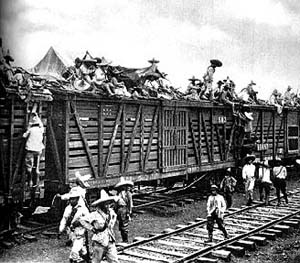
Young Federal soldier in a train station in México


But in towns they won by means of force some men did outstand as brave warriors, some as unsubordinated and some as proactive fighters. One of these battles was to become a milestone for the triumph of Revolution: the battle of Ciudad Juárez.
Madero and his Generals after the fall of Ciudad Juárez in the front of La Casa de Adobe.
Sit from left to right, Caranza; behind him, Villa. Left to Villa, Gustavo Madero. 

 Obviously important to survival of the near to end Revolution and essential for supplying and feeding the villista army in the next to come Revolution, Ciudad Juárez became a centerpiece in the revolutionary map.
In this absurd fight a touch of color: Máximo Castillo, one of maderista chiefs was stand aside Francisco I. Madero in the battle of Casas Grandes, prior to battle of Ciudad Juárez. They were losing the skirmish and bullet flied near to them. “Let´s lay down!” they say Castillo shouted. “No” Madero answered. “We´ll got dusty”.
On may 10th 1911 begun the siege of Ciudad Juárez under the menace of an American intervention if one single bullet cross into American territory (this absurd pretentious way of American Government), supported by the displacement of 20 thousand soldiers to the border region ordered by President Taft.
South of Ciudad Juárez at la Casa de Adobe, a rudimentary house turned into a Op-Center Command of revolutionary forces, Madero asked politely the surrender of the city.

In Federal Army camp, commanded by old General Juan N. Navarro, they received the request as a joke:


(…) ya sabemos que la gente de El Paso les está llevando uniformes, armas y lonches (…) Lo que deberían traerles son huevos que buena falta les hacen (…)


“I could not tolerate this” Villa said. But Madero prohibited any military action without his consent, partly because of stating his command before his troops and mostly because the American threat. Villa and Orozco decided to order their men incite a battle with federal soldiers (while both of them were at El Paso slurping ice cream). The men accomplished their mission involving federal troops in a firefight. When Madero was aware and asked Villa and Orozco for responsibilities, it was too late. Orozco and Villa, maybe smiling, shrugged and said: “Pos…”. “What are you going to do?” said Madero and ordered a full attack on Ciudad Juárez that finally fall down a day like this, May 21st, one hundred years ago just 9 miles from where I´m sitting now, writing these words. Four days after that General Díaz left Mexico in the boat Ypiranga, six months after that Madero swore as President of the Republic and three months after that he was killed in Mexico City.
Once Madero got to Mexico City on June 7th 1911 (that very morning an earthquake hit the Nation´s Capital), he summoned to general voting and won the Presidency against “official” candidate Francisco León de la Barra. On November 6th 1911, Madero protested as President and José María Pino Suárez as Vice-President.
President Madero and Vice-President Pino Suárez


Many of the veterans of maderista fights felt that Madero betrayed them ´cause they´re situation in the country was the same than before the Revolution and the so promised lands to come haven´t came yet. So, many of them rise in arms again, this time against the regime they helped to install. One of the leaders of that new Revolution was named Pascual Orozco, the man that incited the Ciudad Juárez combat aside Francisco Villa, the latest still loyal to Madero, fight against Orozco and his colorados. While this was happening along all the nation, Madero received the morning of February 9th 1913 with the notice of Generals Bernardo Reyes and Félix Díaz had been released from jail by General Manuel Mondragón and that they was leading a military coup d´etat against him. The Mexico City chief of gendarmerie, General Federico González Garza gathered in Presidency Residence, the Chapultepec castle, his forces and many cadets of the Military College to escort Madero all the way to Palacio Nacional where Bernardo Reyes, seditious General of the revolt, had just been killed by Government forces.
González Garza was injured and Madero had to replace him with General Victoriano Huerta.


 General Victoriano Huerta

From this moment and so on until Madero´s capture and dead, I can see a shocking parallelism between Francisco I. Madero and Salvador Allende fall in Chile´s military coup.
Madero needed a gendarmerie commander able to guide the defense of the City so, a military man was the better option and Madero chose Huerta ´cause of his military expertise. Allende in Chile did so with Augusto Pinochet even when Orlando Letelier (by the momento of the coup d´etat on September 11th 1973 he was the Defense Minister) tried to aware Allende about the imminent betray of Pinochet, asking Allende to kill him. In Mexico, sixty years before, Gustavo Madero tried to beware his brother Francisco about the imminent betray of Huerta, asking Madero to kill him.
None of both presidents listened to their advisors and both of them were betrayed by those whom cried before them on a pledge allegiance. Madero faced Huerta in Palacio Nacional and Huerta cried out he was loyal. Allende faced Pinochet in Palacio de la Moneda and Pinochet cried out he was loyal.
Up: Francisco and Gustavo Madero.
Down: Orlando Letelier and Salvador Allende


So, Madero was held prisoner in Palacio Nacional by General Aureliano Blanquet, an old military who commanded the firing squad that killed Maximiliano I de Habsburgo in the end of the Second French Intervention in Mexico. Madero was held prisoner with Vice-President Pino Suárez and General Felipe Ángeles, former chief of the Brigada de Artillería commanded by Pancho Villa. Madero and Pino Suárez were murdered in a dirty and dark street aside to Lecumberry jail. Ángeles was set free as a consideration to his military rank. Big mistake, indeed.

 In coat, Huerta. Two sides to his left is General Aureliano Blanquet


Retired to civil life in Chihuahua, General Francisco Villa went to México for Madero´s burial and cried on the coffin, possibly swearing for revenge. Back in northern Mexico, Villa rise the men who fought aside him against General Díaz and General Orozco and begun the campaign that will end with the constitution of the División del Norte. A regular, well organized and perfectly girt and incredibly mobile army of more than thirty thousand men and a similar number of horses, formed by near of fifty brigades in which, even in the smallest, the head was custodian of the power if his men.
So the División del Norte faced Huerta´s army aside the other Divisiones: that from Sonora under command of Álvaro Obregón and that of Coahuila under command of Venustiano Carranza. This man, the long white beard, the spectacles, the high boots, will become a center character in the future of Villa and the American invasion leaded by Pershing in 1916.


Venustiano Carranza, self-proclaimed "El primer Jefe", The First Chief


[1] Aguilar-Camín H, Meyer L, A la sombra de la Revolución Mexicana, Cal y Arena edit., México 1989

miércoles, 9 de febrero de 2011

Balam VIII


 -No digas pendejadas… si esto fuera una novela se llamaría Los motivos de Clarice o alguna estupidez parecida.
Estaba en la calle Topacio, cerca de La Merced, ese barrio lleno de prostitutas aburridas y casas de bicicletas.
-No. Es un tipo que mata en serie. Todos los homicidios tienen cosas parecidas.
-Claro: los muertos.
-No seas simple. Hay algo más.
-¿Vas a comerte esto? –Le arrebató el vaso de fruta picada con chile.
Se levantó del cofre de la patrulla y empezó a andar sin esperar a ver si su compañero lo seguía. El otro lo alcanzó corriendo, los faldones de la camisa revoloteándole el cinto que hacía juego con las botas.
-¿Te han dicho que pareces policía judicial? –le preguntó con cierto interés.
-Nunca. ¿A ti te han dicho que pareces policía?
-Todos los días.
Con el sol brillando sobre sus cabezas se alejaron por entre los puestos de películas piratas y ropa barata.