domingo, 10 de julio de 2011

The Punitive Mexican Expedition III

A brief review of a two-sided story
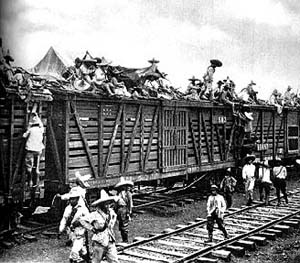


PART THREE

War is not merely an act of policy but a true political instrument, a continuation of political intercourse, carried on with other means
Carl Philipp Gottlieb von Clausewitz
German military theorist

De todos los Madero, fueron a elegir presidente al más tonto
Gustavo A. Madero


Once Madero was held prisoner and forced to resign presidency, Pedro Lascuráin, by the time Secretary of Exterior Relations was constitutionally elected President of the Republic as long as 45 minutes, time just to appoint Huerta in the Secretary he has just left and resign himself to presidency, automatically making Huerta the new President of Mexico.
The murder of Madero and Pino Suárez is precisely related in Taibo´s Temporada de Zopilotes.[1] Synthesizing his narration, once Blanquet held Madero, Huerta kept him in the quartermaster of Palacio Nacional aside the Vice-President and General Felipe Ángeles. But there were no a visible head of the coup d´etat, and Huerta took advantage of this situation shaping up as the leader once the very promoters of the revolt had been killed one and subordinated the other to Huerta´s orders. He sent a hitman, Major Francisco Cárdenas, to kill Madero in these terms:

– We know, Cárdenas, that you´re a man who knows how to do what is ordered. The one that killed a Santana[2] can easily kill a Madero. Don´t be shy. It´s not the first time you kill a man.
– Yes, my General, but no one this size.
– Very shortie, he is.[3]
– And must die all three?
– Well, Ángeles may stay, but the other two must die today without dilation.

So Madero was taken from his prison and introduced in a rented Protos and Pino Suárez in a so rented Peerless, the first escorted by Major Cárdenas and Corporal Francisco Ugalde and the second escorted by Corporal Rafael Pimienta and Officer Agustín Figueres. It was 2220 hours on February 22nd 1913,[4] and the two cars left Palacio Nacional heading to Lecumberri Penitentiary, less than a mile away. Parking behind the prison, Cárdenas shouted, pushing Madero: “Off you go, damn it!” and shoot him twice in the head, from behind. Pino Suárez tried to run but he was reached by the bullets of Pimienta; wounded and with a broken leg, Vice-President was killed by Cárdenas and Pimienta. The autopsy showed thirteen wounds in his body. The corpses were buried in a ditch and covered with rocks.

Palacio Nacional after apprehension of Madero and Pino Suárez
 
With the end of maderist presidency, Huerta decided to dissolve Congress and begins trades with the American Embassy commanded by Henry Lane Wilson who, in fact, actively participated in the coup d´etat generating a political agitation in the days between the Bernardo Reyes and Félix Díaz rising and the killing of Madero.

 Mexico, history of: Huerta mocked in political cartoon. Photograph. Enciclopaedia Britannica Online. Web. 10 Jul 2011. Swann Collection of caricatures & cartoon/Library of Congress, Washington D. C. (LC-USZ62-85449), by Thomas E. Powers, 1913

All these illegal acts unchained the rage of the army Generals (very late, I should say) and provoked the signing of the Plan de Guadalupe by General Venustiano Carranza Garza. One should give a glimpse on this man: born in Cuatro Ciénegas, Coahuila, he was son of a prominent farmer and elected Mayor of his town. He held a political struggle against Governor Garza Galán supported by Bernardo Reyes, Commissioner of Porfirio Díaz, in 1894. After that he supported the campaign of Reyes against Porfirio Díaz and added to Madero´s campaign from exile in San Antonio, Texas.
Once Revolutionary Army conquered Ciudad Juárez, Madero elected him to be Governor of Coahuila, a political place he had desired since he was Mayor. After that and when Madero was elected President, Carranza Garza occupied the Secretary of War and Navy. He seemed not to like Villa´s natural scent.

From the left: Emilio Madero (?), Pancho Villa, Venustiano Carranza, José María Pino Suárez y José Medinabeytia, in Chihauhua, 1914. Villa and Carranza viewing opposite sides. They did not like each other.

Aware of Huerta´s coup, Carranza declared himself in default and refused to recognize the Huerta´s government, holding the rank of First Chief of the Revolution (a rank he desired since the days of first Mexican Revolution), as said in the Plan de Guadalupe, proclaimed in March 26th 1913.[5] In southern México, on the other hand, Emiliano Zapata, leader of Liberating Army of South, modified the Plan de Ayala, document in which people of Morelos state deplores Porfirio Díaz regime to deplore Huerta´s coup, without subordinating to Carranza´s orders and begins a parallel war against Huerta.[6]

 Palacio Nacional. In the middle, Villa sited in Presidential Chair. To his left, Zapata, holding a huge hat.

Carranza rise the army from northern México in three big corps: Northwest Army under command of General Álvaro Obregón in Sonora where José María Maytorena was Governor, Northeast Army under command of Pablo González Garza in Coahuila, state governed by Carranza himself and, lately, the Northern Division commanded by Francisco Villa in Chihuahua, where the Governor was Abraham González.[7]
Once up in arms, Carranza´s army was easily defeated and The First Chief crossed all the biggest states of northern México from Coahuila to Sonora to join Obregón´s army. In Chihuahua, on the other hand, the revolt wasn´t unified and there were many guerrillas fighting against federal troops, one of these commanded by Villa who, lately, will be elected commander in chief of Northern division. In this political convulsed river, the fisherman made them profit and Pascual Orozco negotiated with Huerta´s government, legalizing it. So he was pursuit and defeated by Villa lately.
Carranza sent to Chihuahua to Juan Sánchez Azcona and Alfredo Breceda trying to get Villa´s submission to his very power. Villa decided to join the Constitucionalista army (so named by Carranza) only if Chihuahua territory was not to be under the command of Sonora´s military and himself was not to be under any command. By the time, Chihuahua was torn by bandits and “gavillas” of thieves so, Villa, far from face the government troops dedicated his forces to pursuit and eliminate these gavillas, bringing back to the state the tranquility it has lost, wining, by the way, the respect of people cause his army was severely punished if there was any act of vandalism after their entrance to any town.[8]
Villa was never subordinated to Carranza´s power and operated always in his own terms of internal government and chains of command keeping in mind his primary objective: the defeat of Huerta. But Carranza was looking forward, watching himself in the Presidency. And Villa and his power in the biggest state of the Republic was an obstacle to him. When the fight moved southbound and won territories and cities, one of those being Torreón, Coahuila, Carranza begun to show an authoritarianism that divided the army. 

Maybe the most popular photograph of Pancho Villa, misknown as The Fall of Torreón, it was taken in Zacatecas.
Once Torreón was in hands of the revolutionaries, Carranza tried to separate the División del Norte sending Villa and a little column of this corps to support Pánfilo Natera´s army in the assault to Zacatecas city. Villa refused, in polite terms to do so and Carranza insisted. It was June 11th 1914. Carranza received a telegram from Villa proposing to move not only a column of his forces, but the entire Division, but Carranza insisted in sending not only three thousand, but five thousand men to support Natera. The next day, Villa sand a new telegram to Carranza saluting him and apologizing to be unable to help Natera questioning him for his decision to attack Zacatecas by himself instead of waiting for Northern Division. By the way (maybe as a probe to Carranza), Villa asks the First Chief to name a new commander of the Division. Natera failed in taken Zacatecas; even more, his army was almost annihilated. Carranza answered Villa that, if he had accomplished the orders himself had send Villa, Zacatecas would be under their rules. Taibo says:

In the conference, Carranza argued that if Villa had not received the supports that Carranza send him in Torreón with Durango corps, (Villa) he would not been able to take it. He is not proposing Villa to subordinates to General Natera; it´s all about that “he takes the city and expedites the way for himself southbound”. And, insists, victim of the authoritarianism that obsessed him: “Natera will stand for two days. Send (Eugenio Aguirre) Benavides, (Jesús) Ortega, (Calixto) Contreras or whomever you want”.
It has become an authority duel begun as a political maneuver (…). “The reason that was heavier in the spirit of Mr. Carranza to avoid Villa to take Zacatecas was that, once it has fall, he could be able to continue his march to México City”. [9]

Villa resigned to the command of the Northern Division and called Felipe Ángeles (that one that was held prisoner aside Madero) to give him the command of the forces. Ángeles fears the cracking of the Division which, in fact, it´s about to happen. Some of the military menace to go to the sierras and begin a guerrilla against Carranza. Villa sent a telegram to General Álvaro Obregón in Sonora, informing him about his resignation. Obregón and Villa had met in Ciudad Juárez, Chihuahua. The meeting was, surprisingly, witnessed by General Pershing; there is a photo in which a young Lieutenant George Patton shows a naive smile. Carranza asked the generals supposedly gathered in the telegraph office in Torreón to designate the chief that would replace Villa. The generals answered asking Carranza to reconsider Villa´s resignation in view of his services to revolution. Carranza asked to designate another chief. The generals stand clearly that Carranza would not be able to go over the División del Norte and its chains of command based in the popular election of its chiefs:

We could, following the example of sir General Villa, let the command of our troops dissolving so the División del Norte, but we cannot deprive our cause of a so valuable element of war. So, we are about to convince the chief of this División to continue the fight against Huerta´s government as if no unpleasant event had happen today and we admonish you to do same, to defeat our common enemy.[10]

Carranza, deaf to reason, asked them to designate a new chief. General Maclovio Herrera, partner of Villa since the beginnings of Madero´s revolution, and infinitely more prosaic, telegraphed to Carranza:

Mr. Carranza: I´m aware of your behavior toward my General Francisco Villa. You are a son of a bad woman.[11]

But the other generals, modestly more moderated, answered:

Torreón, June 14th, 1914. Mr. V. Carranza. First Chief of the Constitucionalista Army, Saltillo, Coahuila. Your last telegram made us to suppose you had not or wanted not to understand our two last telegrams. They says in its medullar part that we do not take in account your order to General Villa resign the command of the División del Norte, and we could not assume another position against this apolitical, anti-constitutional and anti-patriotic action. We have convinced General Villa to understand that his compromise to the Homeland obligates him to continue in command of this corps (…)[12]

Carranza would be, in a near future, pursuit by Villa in his runaway from Mexico City to Veracruz and Coahuila. When Carranza (enthroned as the Máximo Mexicano) knew of the approach of Villa´s army by the north and Zapata´s army by south, charged a train with all his stuff, the Presidential Chair included, and begun a itinerant government trying to emulate President Juárez. When the villistas finally reached Mexico City, says the legend, one of the troopers saw the chair in which Villa and Zapata was photographed and asked:

And we are killing each other ´cause of this thing?[13]

Villa and Zapata entering México City. Villa surprisingly in uniform and Zapata with his charro usual clothes.

[1] Taibo II, PI, Temporada de Zopilotes, una historia narrativa de la Decena Trágica, editorial Planeta Mexicana, México, 2009, 155 pp.
[2] Refering to the killing of Santana Rodríguez, a magonist guerrilla from Veracruz.
[3] Sarcasm related to Madero´s size: he was 4´ 8” tall.
[4] Coincidently, this day was celebrated the birthday of George Washington with a reception in the American Embassy. After ordering the murder of Madero, Huerta went to the Embassy to celebrate with Ambassador Wilson.
[5] Instituto Nacional de Estudios Históricos de las Revoluciones Mexicanas, INEHRM, Página del Bicentenario, consulted on http://www.bicentenario.gob.mx, on July 10-07-2011.
[6] Instituto Nacional de Estudios Históricos de las Revoluciones Mexicanas, INHERM, Op. cit.
[7] Salmerón P, La Divisón del Norte, the land, the men and the history of a people´s army, Booklet, Planeta Mexicana editorial, México, 2006, page 299
[8] Salmerón P, Op. cit.
[9] Taibo II, PI, Pancho Villa, Una biografía narrativa, Editorial Planeta Mexicana, 2006, México, pp. 372
[10] Salmerón P, Op. cit. page 454
[11] Taibo II PI, Op. cit. Page 373
[12] Salmerón P, Op. cit. page 456
[13] For most fighters, “the chair” was the coloquial way to refer to the Presidency, to the Power of the Nation. Even today, political struggle is called the Fight by the Chair.

lunes, 4 de julio de 2011

Soneto


En 1966 un joven estudiante ingresó a la Escuela Preparatoria Nocturna Benito Juárez de Ciudad de México. Una fotografía que se conserva de él (tomada unos pocos años después), lo muestra con uniforme militar, sin galones ni medallas, las mejillas ligeramente abultadas, sonriente, mirando al horizonte, con la mano derecha apoyada en una árbol delgado, la pierna derecha ligeramente adelantada y con el cuartel militar de fondo. En el momento en que él ingresó a la escuela nocturna debió ser un poco más delgado.
Originario de Ixtaltepec, en el Istmo de Tehuantepec, Oaxaca, inició la educación primaria a los 9 años hablando sólo zapoteco. Esto debió representarle un obstáculo mediano ya que la mayoría de sus compañeros en el Istmo también hablaban zapoteco; pero entró a la secundaria de 19 años, después de un impass obligado por la situación económica.
En 1967 tomó un curso de literatura dentro del programa educativo de la Preparatoria. Y dentro de ese curso debió estudiar lo que era un soneto.

Soneto: del It. Sonetto y del Lat. Sonus, sonido. m. composición poética que consta de catorce versos endecasílabos distribuidos en dos cuartetos y dos tercetos. En cada uno de los cuartetos riman, por regla general, el primer verso con el cuarto  y el segundo con el tercero, y en ambos deben ser unas mismas las consonancias. En los tercetos pueden ir éstas ordenadas de distintas maneras.

Ateniéndonos a la leyenda, cuando el maestro leyó los trabajos y llegó al de nuestro joven estudiante preguntó quién era el autor y, sorprendido y seguramente un poco avergonzado y temeroso, el muchacho se levantó. El maestro le hizo leer el soneto para toda la clase y después de concluido el último terceto, felicitó al mozalbete.
El soneto dice, a la letra:

La flor marchita

Cual hojas secas que arrebata el viento
pasaron ya tus días de primavera,
la vida para ti fue pasajera,
¡Oh, bella flor! No sabes cuán lo siento.
De haberte marchitado me arrepiento,
no quiero ni pensarlo tan siquiera,
pues sólo de pensar en tu quimera
la pena me arrebata el pensamiento.
Vivir sin tu fragancia cruel ha sido:
no puedo soportar el no tenerte
pues sólo de pensar que te hayas ido
dejándome tan solo con mi suerte
y al ver que no regresas ¡clamo y pido!:
no quiero más vivir, ¡venga la muerte!

Francisco Marcos–Toledo
Ciudad de México, 1967

Seguramente no es la más pulida obra de su género, pero cuando mi padre lo escribió hace ya tantos años y cuando yo lo escuché, de nuevo, recitado por su voz cascada por el cigarro y la edad, con la dificultad de pronunciación que la enfermedad y los años le han dejado, no pude menos que comprometerme a publicárselo en este espacio.
Espero que lo hayan disfrutado tanto como yo.
Te amo, papá.

viernes, 24 de junio de 2011

Balam IX


Llovía.
Era una lluvia pertinaz y cruda, de esas que sólo pueden suceder en Ciudad de México. Constante, sucia, gris más allá del gris del cielo.
Como si llovieran cenizas.
Estaba parado detrás del ventanal del balcón. Pensaba. Aunque, no. En realidad, recordaba.
La vida estaba hecha de jirones de escenas y momentos vividos antes: la casa paterna, con su pasillo una vez lleno de helechos y macetas y luego derruido por la soledad, por la falta de interés; la neblina en aquella escuela donde cursó su primer año de universidad; los días de sol radiante cuando ella estaba con él; luego… de nuevo la lluvia de una tarde en que se reunió con ella, sonriente, esperando un reencuentro y en que se dio de frente conque que ella se sentaba como una adolescente en las piernas de ese otro venido del pasado, de un pasado que no era el suyo.
El dolor, la vergüenza, el alcohol, el vómito, el dolor, el sentirse excluido de esa vida que pretendió compartir y que se le negaba.
Encendió un cigarrillo. Y recordó: si no fuera porque no podía dejar de fumar, bien podría dejar de fumar. Pero eso lo leyó en una novela policiaca y cayó en la cuenta que jamás había hecho nada original. Claro (se consoló): la vida está hecha de jirones de…
Pero el nombre de ese tipo le regresaba a la cabeza como un insulto (él lo sentía como un insulto), repetitivo, soez, vulgar, ni siquiera un nombre de verdad, sólo un apócope.
A lo lejos sonó una sirena. Estaba harto.
Caminó hacia su cama y trató de dormir.
Aunque sabía, por experiencia, que sería inútil.

jueves, 16 de junio de 2011

Como disculpa...


He de decir que antes me preguntaba: Por qué no hay comentarios en el blog, si tengo suficientes visitantes a los posts? Obviamente, la respuesta es que los comentarios estaban esperando moderación.
Una vez que he descubierto esto de la regulación de comentarios, voy a publicar todo lo que no sea publicidad, anuncios eróticos, promociones para hacer crecer el pene, suplementos alimenticios y páginas pornográficas (no porque me molesten -que no lo hacen- sino porque esto tratando de que este sea un sitio serio), sean a favor o en contra (las dos opcines son bienvenidas) en pro de la pluralidad de opiniones.
Por favor, escriban sus comentarios.

Los que quieran hacerse seguidores, por favor, háganlo en el apartado correspondiente.
Además, ahí está mi correo para que me contacten.
Gracias por sus visitas.
Cualquier pregunta o comentario que deseen tenga respuesta por parte de un servidor, háganla por correo para que yo lo publique después y lo conteste, si es que mi irresponsabilidad literaria lo permite.
Un abrazo al amigo que habla portugués... es la opinión de ambos lados lo que cuenta, para el amigo que pregunta qué pasa si lo ven desde otro punto... al amigo que habla serbio? rumano? checo?, gracias por el comentario... a la lectora que se dedica a los techos, le mando un beso.
Los comentarios halagodares son buenos, los comentarios críticos son buenos, también. Espero seguir recibiendo de ambos tipos.

martes, 24 de mayo de 2011

The Punitive Mexican Expedition II

A brief review of a two-sided story

Expeditionary troops south the border


PART TWO

México es kafkiano,
no tenemos pa´ elegir.
Como Cristina Pacheco dijo:
aquí nos tocó vivir.
Salvador Vélez Rodríguez / Ricardo Marcos-Serna
(J)oda a la Revolución, fragment


(…) desde el momento en que un gobernante no respeta la ley, no tiene otra regla a qué sujetar sus actos sino a sus propias pasiones (…)
Francisco I. Madero


One can´t tell the story of these Revolutions without making time gaps between its chapters. A Revolution is not merely a social movement but a living being, an animal that feeds in haunted places, that drinks blood of the men dying in battles, that dreams of strategy, betrayal, loyalty, braveness and fear. Who said “War is politics continued by other means”?
The first ten years of 20th Century were harmful for Mexico. It´s Government ruled out by a tyrant during thirty years, society as fragmented as Congress, earthquakes both political and geological, drought, corn and bean production reduced, forced armed recruitment, famine, all of these things contributing to a rise of political opposition.[1] 
Madero crossed the American-Mexican border, briefly, on November 20th 1910. Hopping, perhaps, to see the country set in flames, he did found no more than a reduced group of men in the so called Ciudad Porfirio Díaz (today named Piedras Negras, Coahuila) and shortly after that returned to the USA and waited until February 14th 1911 when he crossed again southbound at Zaragoza Distrito Bravos, Chihuahua, and lead definitely the revolt until General Díaz resigned Presidency on May 25th 1911. 
Trough those 186 days, Mexico lived and starred the first Revolution of the century in the wide world. And was in this period of 186 days when Francisco Villa begun to gain a place in History. Graded as Captain on Revolutionary Army, Villa was subordinated to a chief (Máximo Castillo) that he did not consider other thing that inept and dumb. 
The Revolutionary Army faced a Federal Army in deplorable conditions: payless, hungry, barefoot in some cases, most of its troopers forced to be there and facing an irregular corps of well motivated men that gained confidence as they gained terrain, as they took towns and cities, sometimes in a bloody way, sometimes –as in the case of Colima and Michoacán, without shooting a single bullet.

Young Federal soldier in a train station in México


But in towns they won by means of force some men did outstand as brave warriors, some as unsubordinated and some as proactive fighters. One of these battles was to become a milestone for the triumph of Revolution: the battle of Ciudad Juárez.
Madero and his Generals after the fall of Ciudad Juárez in the front of La Casa de Adobe.
Sit from left to right, Caranza; behind him, Villa. Left to Villa, Gustavo Madero. 

 Obviously important to survival of the near to end Revolution and essential for supplying and feeding the villista army in the next to come Revolution, Ciudad Juárez became a centerpiece in the revolutionary map.
In this absurd fight a touch of color: Máximo Castillo, one of maderista chiefs was stand aside Francisco I. Madero in the battle of Casas Grandes, prior to battle of Ciudad Juárez. They were losing the skirmish and bullet flied near to them. “Let´s lay down!” they say Castillo shouted. “No” Madero answered. “We´ll got dusty”.
On may 10th 1911 begun the siege of Ciudad Juárez under the menace of an American intervention if one single bullet cross into American territory (this absurd pretentious way of American Government), supported by the displacement of 20 thousand soldiers to the border region ordered by President Taft.
South of Ciudad Juárez at la Casa de Adobe, a rudimentary house turned into a Op-Center Command of revolutionary forces, Madero asked politely the surrender of the city.

In Federal Army camp, commanded by old General Juan N. Navarro, they received the request as a joke:


(…) ya sabemos que la gente de El Paso les está llevando uniformes, armas y lonches (…) Lo que deberían traerles son huevos que buena falta les hacen (…)


“I could not tolerate this” Villa said. But Madero prohibited any military action without his consent, partly because of stating his command before his troops and mostly because the American threat. Villa and Orozco decided to order their men incite a battle with federal soldiers (while both of them were at El Paso slurping ice cream). The men accomplished their mission involving federal troops in a firefight. When Madero was aware and asked Villa and Orozco for responsibilities, it was too late. Orozco and Villa, maybe smiling, shrugged and said: “Pos…”. “What are you going to do?” said Madero and ordered a full attack on Ciudad Juárez that finally fall down a day like this, May 21st, one hundred years ago just 9 miles from where I´m sitting now, writing these words. Four days after that General Díaz left Mexico in the boat Ypiranga, six months after that Madero swore as President of the Republic and three months after that he was killed in Mexico City.
Once Madero got to Mexico City on June 7th 1911 (that very morning an earthquake hit the Nation´s Capital), he summoned to general voting and won the Presidency against “official” candidate Francisco León de la Barra. On November 6th 1911, Madero protested as President and José María Pino Suárez as Vice-President.
President Madero and Vice-President Pino Suárez


Many of the veterans of maderista fights felt that Madero betrayed them ´cause they´re situation in the country was the same than before the Revolution and the so promised lands to come haven´t came yet. So, many of them rise in arms again, this time against the regime they helped to install. One of the leaders of that new Revolution was named Pascual Orozco, the man that incited the Ciudad Juárez combat aside Francisco Villa, the latest still loyal to Madero, fight against Orozco and his colorados. While this was happening along all the nation, Madero received the morning of February 9th 1913 with the notice of Generals Bernardo Reyes and Félix Díaz had been released from jail by General Manuel Mondragón and that they was leading a military coup d´etat against him. The Mexico City chief of gendarmerie, General Federico González Garza gathered in Presidency Residence, the Chapultepec castle, his forces and many cadets of the Military College to escort Madero all the way to Palacio Nacional where Bernardo Reyes, seditious General of the revolt, had just been killed by Government forces.
González Garza was injured and Madero had to replace him with General Victoriano Huerta.


 General Victoriano Huerta

From this moment and so on until Madero´s capture and dead, I can see a shocking parallelism between Francisco I. Madero and Salvador Allende fall in Chile´s military coup.
Madero needed a gendarmerie commander able to guide the defense of the City so, a military man was the better option and Madero chose Huerta ´cause of his military expertise. Allende in Chile did so with Augusto Pinochet even when Orlando Letelier (by the momento of the coup d´etat on September 11th 1973 he was the Defense Minister) tried to aware Allende about the imminent betray of Pinochet, asking Allende to kill him. In Mexico, sixty years before, Gustavo Madero tried to beware his brother Francisco about the imminent betray of Huerta, asking Madero to kill him.
None of both presidents listened to their advisors and both of them were betrayed by those whom cried before them on a pledge allegiance. Madero faced Huerta in Palacio Nacional and Huerta cried out he was loyal. Allende faced Pinochet in Palacio de la Moneda and Pinochet cried out he was loyal.
Up: Francisco and Gustavo Madero.
Down: Orlando Letelier and Salvador Allende


So, Madero was held prisoner in Palacio Nacional by General Aureliano Blanquet, an old military who commanded the firing squad that killed Maximiliano I de Habsburgo in the end of the Second French Intervention in Mexico. Madero was held prisoner with Vice-President Pino Suárez and General Felipe Ángeles, former chief of the Brigada de Artillería commanded by Pancho Villa. Madero and Pino Suárez were murdered in a dirty and dark street aside to Lecumberry jail. Ángeles was set free as a consideration to his military rank. Big mistake, indeed.

 In coat, Huerta. Two sides to his left is General Aureliano Blanquet


Retired to civil life in Chihuahua, General Francisco Villa went to México for Madero´s burial and cried on the coffin, possibly swearing for revenge. Back in northern Mexico, Villa rise the men who fought aside him against General Díaz and General Orozco and begun the campaign that will end with the constitution of the División del Norte. A regular, well organized and perfectly girt and incredibly mobile army of more than thirty thousand men and a similar number of horses, formed by near of fifty brigades in which, even in the smallest, the head was custodian of the power if his men.
So the División del Norte faced Huerta´s army aside the other Divisiones: that from Sonora under command of Álvaro Obregón and that of Coahuila under command of Venustiano Carranza. This man, the long white beard, the spectacles, the high boots, will become a center character in the future of Villa and the American invasion leaded by Pershing in 1916.


Venustiano Carranza, self-proclaimed "El primer Jefe", The First Chief


[1] Aguilar-Camín H, Meyer L, A la sombra de la Revolución Mexicana, Cal y Arena edit., México 1989

martes, 22 de febrero de 2011

Polígono de lectura (experimental)


A la comunidad del Blog.

Propongo ante los visitantes del blog crear un grupo de lectura en el que, por decisión de la mayoría de los que deseen participar, podamos poner un archivo en este sitio para que ustedes puedan descargarlo y leerlo y lo comentemos en conjunto, aportando cada uno sus opiniones sobre el libro en cuestión.
Quien esté interesado en participar en este ejercicio puede mandar sus sugerencias sobre la obra que quisiera tratar a mi correo electrónico con fecha límite (digamos) el 5 de marzo. Es indispensable que los libros porpuestos estén disponibles en versión electrónica para poder compartirlos en este sitio con otros usuarios. La lista de los libros candidatos será publicada un día después de la fecha límite para presentar propuestas y se someterá a votación. El que obtenga más votos será el libro que leamos y comentemos juntos.
Quien esté interesado en este proyecto, escriba a rmarcosserna@yahoo.com.mx y proponga un libro, ensayo, película, canción, disco, video, cortometraje o lo que le interese y poseea para poder compartirlo versión electrónica.
Espero contar con la participación de ustedes. 
Gracias. 

Crédito de la imagen a http://www.google.com/imgres?imgurl=http://educontinua.files.wordpress.com/2009/03/pinney.jpg